
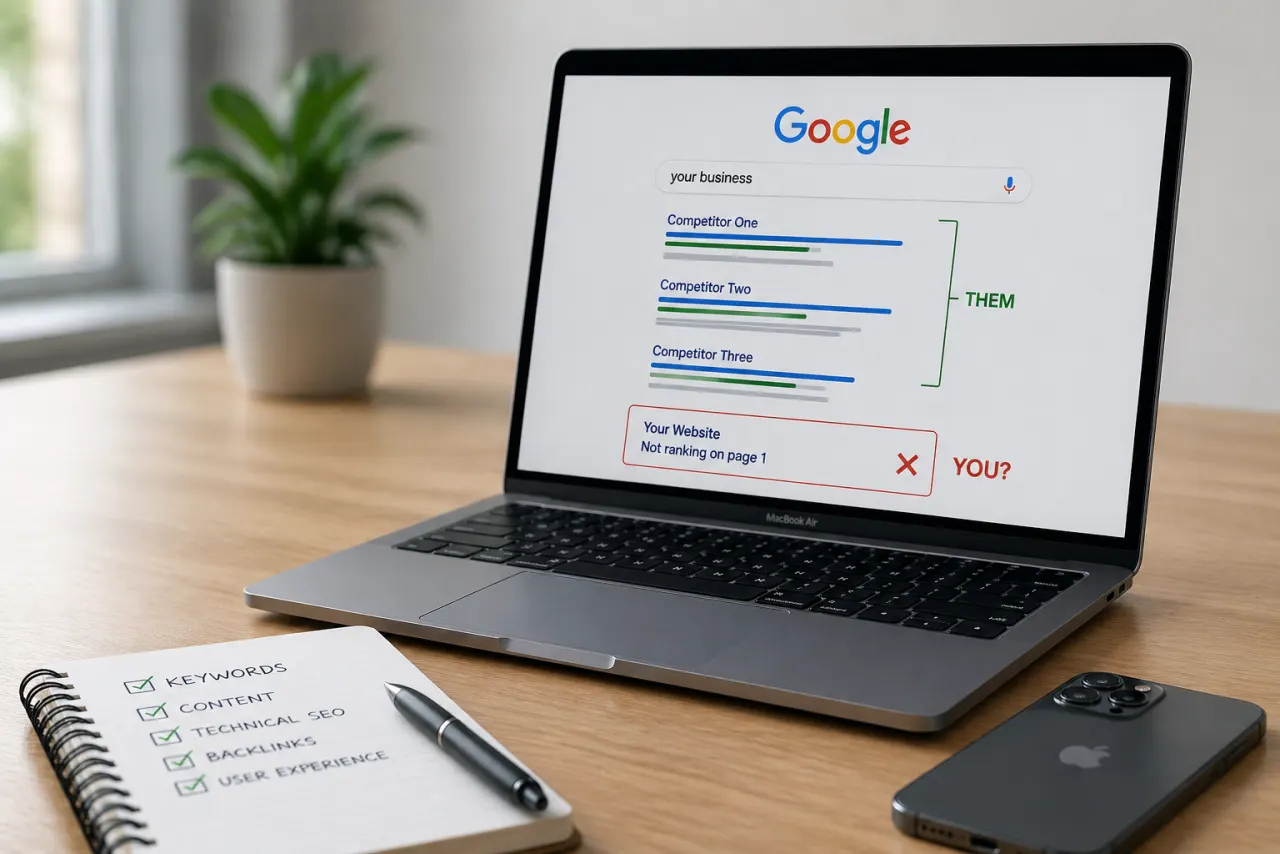
You’ve got a website. It looks the part, it’s live, and on the surface there’s no obvious reason it shouldn’t be doing well.
But when you search for your services, nothing shows up. Not on page one, not on page two, sometimes not at all unless you type your exact business name in.
It’s frustrating, and it’s more common than most people realise.
The assumption is usually that something is “wrong” with Google, or that rankings are random. In reality, Google is quite predictable. If a website isn’t appearing, there’s always a reason behind it. Often more than one.
One of the biggest issues tends to be direction. A lot of websites aren’t built around what people are actually searching for. They’re written from the business owner’s point of view rather than the customer’s. That might sound like a small difference, but it’s not. If your pages don’t line up with real search terms, Google doesn’t have anything meaningful to rank you for.
It’s quite common to see sites trying to rank for broad phrases like “web design” or “SEO”. The problem is those terms are incredibly competitive and usually dominated by large agencies with years of history behind them. On the other end of the scale, some sites don’t target anything specific at all. They just exist, with general wording that could apply to almost any business. Neither approach works particularly well.
Then there’s trust, or what Google would see as authority. If your website is relatively new or hasn’t built any kind of reputation, it’s unlikely to appear near the top of results. One of the main signals here is links from other websites. Not spammy directories or low-quality listings, but genuine mentions from relevant sources. Without those, your site is essentially operating in isolation, and Google has no strong reason to prioritise it over others.
Content plays a bigger role than many expect as well. Not just having content, but having the right kind. A surprising number of business websites say very little when you actually read them. Short service pages, vague claims, and wording that sounds polished but doesn’t really explain anything. From Google’s perspective, that’s not useful. From a user’s perspective, it’s not convincing either. The sites that perform well tend to go deeper. They answer questions properly, explain how things work, and show a clear understanding of what the user is looking for.
There are also the quieter issues that sit in the background. Things like slow loading speeds, pages that aren’t being indexed, or a site that doesn’t work properly on mobile. None of these are always obvious when you first look at a website, but they can have a noticeable impact on visibility. A slow site in particular tends to cause problems on two fronts. It makes Google less likely to favour it, and it makes users more likely to leave.
For businesses operating in a specific area, location often gets overlooked. If your site doesn’t clearly indicate where you’re based or who you serve, it becomes much harder to appear for local searches. People aren’t just searching for services, they’re searching for services near them. If your website doesn’t reflect that, you miss out on a large portion of potential traffic.
And sometimes, the answer is simply time. New websites don’t tend to rank straight away. Google takes a while to crawl and understand a new domain, and even longer to trust it. That said, time on its own doesn’t fix anything. The sites that improve are the ones that actively build content, improve performance, and develop authority rather than waiting for something to happen.
What usually works best is focusing on the fundamentals and doing them properly. Making sure each page has a clear purpose. Writing content that actually answers the kinds of questions your customers are asking. Fixing any technical issues that could be holding things back. Gradually building credibility through links and mentions. None of it is particularly glamorous, but it’s what moves the needle.
It’s also worth being realistic about expectations. Ranking on Google isn’t instant, and it isn’t based on a single change. It’s the result of consistent improvements over time. Small gains add up, especially when they’re focused in the right areas.
If your website isn’t ranking at the moment, it doesn’t mean it’s failed. It usually just means it hasn’t yet reached the level Google is looking for. The positive side of that is it’s rarely out of reach. With the right adjustments, most sites can improve significantly.
The challenge, more often than not, is knowing where to focus. It’s easy to spend time tweaking the wrong things while the bigger issues sit untouched.
That’s usually where experience makes the difference. Understanding how search actually works, what matters right now, and what’s worth ignoring tends to speed things up quite a bit.
At Web Optic, this is exactly the kind of work we do day to day. Looking at what’s holding a site back, fixing what matters, and building it into something that performs properly rather than just looking good.
And once those pieces start coming together, the difference is noticeable. Not just in traffic, but in the quality of enquiries that start coming through.